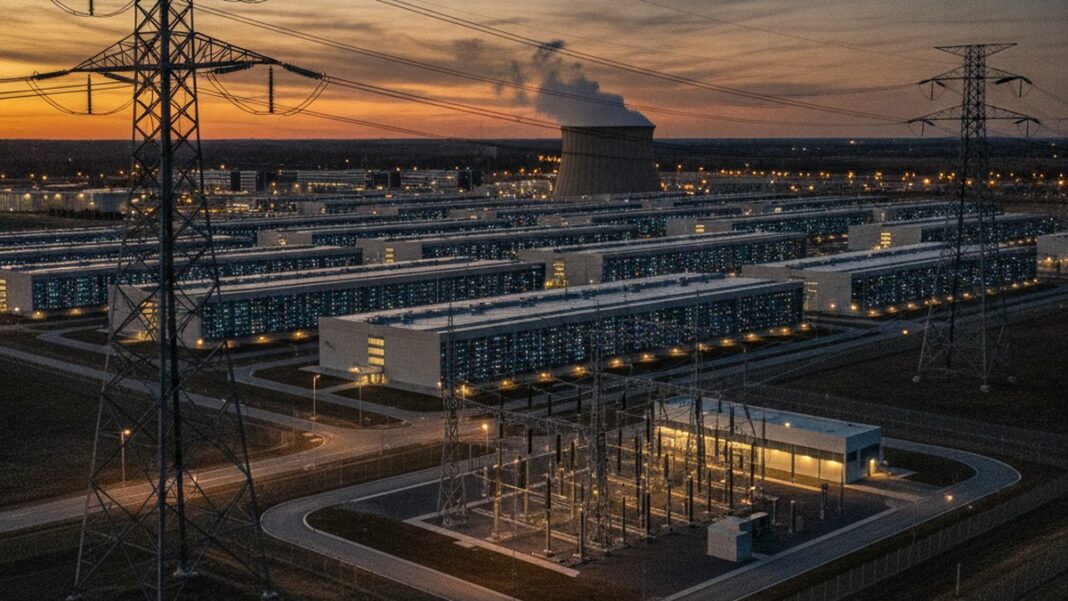

When a report surfaced in late 2025 suggesting that talks between Nvidia and OpenAI over a fresh compute commitment had stalled, Oracle’s share price fell within hours. Oracle had no direct part in that negotiation. It issued a statement anyway, insisting the “Nvidia-OpenAI conversation has zero impact on our financial relationship” with OpenAI. That a company with no seat at the table felt compelled to say so was the more revealing data point: it confirmed how tightly Oracle’s own fortunes now sit inside a negotiation between two other companies.
That afternoon is a reasonable place to start understanding what is fragile about the AI infrastructure boom. It isn’t whether the technology works, or whether enterprises will eventually pay for it at scale. Those questions matter, but they aren’t what’s keeping credit analysts and central bankers awake. The harder question is structural: how much of the revenue growth reported across the AI supply chain reflects independently verified demand, and how much is capital moving in a loop, counted as growth at every stop.
The loop, in numbers
The mechanics are no longer disputed, only their significance is. Nvidia holds equity in the companies buying its chips, including roughly seven percent of CoreWeave and a non-binding commitment of up to $100 billion tied to OpenAI’s build-out. Microsoft owns close to 27 percent of OpenAI, funded partly through Azure credits rather than cash, and stands to receive $250 billion in Azure commitments from OpenAI through 2035. Amazon has put more than $83 billion combined into OpenAI and Anthropic while booking upward of $238 billion in future AWS commitments from the same two companies. OpenAI alone has signed contractual obligations exceeding $1.1 trillion across Oracle, Microsoft, Amazon, CoreWeave, Broadcom and AMD, for compute it hasn’t yet built the revenue base to pay for. None of this is illegal, and little of it is unusual by the standards of how capital-intensive industries have financed build-outs before. What’s unusual is the density of the loop: the chipmaker invests in the buyer, the buyer commits future revenue to the cloud provider, the cloud provider buys chips from the chipmaker, and each leg books the transaction as growth.
When CoreWeave’s stock fell by more than half earlier this year on renewed circularity concerns, then rebounded sharply after its chief executive pushed back publicly, the swing itself was the tell: a company whose fundamentals hadn’t changed in days saw its valuation move entirely on sentiment about how self-referential its revenue base might be. The IMF put it more bluntly in July, warning that “frothy valuations in AI-exporting economies could correct sharply” — unusually direct language for an institution that typically hedges on asset prices.
The depreciation question no one wants to reopen
If circularity is a demand-side problem, the second issue sits on the cost side, and it’s arguably more consequential because it’s entirely within management’s discretion. Hyperscalers currently depreciate GPU fleets over four to six years, a schedule Nvidia and its customers defend as consistent with observed utilisation and hardware longevity. The investor Michael Burry argues that actual replacement cycles for data-centre GPUs under continuous AI workloads run closer to two or three years. His estimate, disputed but not yet refuted with equivalent rigour by the companies concerned, is that the five largest AI hyperscalers could be understating cumulative depreciation, and overstating cumulative earnings, by roughly $176 billion between 2026 and 2028.
Useful-life assumptions are estimates, not facts, and revising them is neither fraud nor automatically a red flag. Amazon shortened certain server depreciation schedules in 2025; Meta moved the other way over the same period. Two companies buying similar hardware for similar workloads have reached different conclusions about how long it lasts, and the gap is worth billions of dollars a year in reported profit that has nothing to do with how the underlying business performed. A CEO needn’t believe the technology is a bubble to recognise that a discretionary accounting estimate is now propping up hyperscaler margins more than most boards have been asked to scrutinise.
Where the leverage actually sits
The third piece, which regulators are only beginning to map, is how much of this build-out has migrated off balance sheets. The Bank for International Settlements notes that hyperscalers increasingly finance data-centre capacity through special purpose vehicles and joint ventures backed by private credit, keeping a minority stake while committing to long-term capacity offtake and guarantees. The effect, in the BIS’s words, “substitutes upfront capex with multi-year operating expenses while keeping most of the associated debt off the hyperscaler’s balance sheet.” AI-linked bond issuance exceeded $100 billion in 2025 and spreads on lower-rated hyperscalers have widened; the private credit funds holding this debt are themselves exposed to redemption pressure if growth disappoints, precisely when guarantees might be called at once.
There’s an imperfect but useful parallel here, worth naming carefully rather than as a scare tactic. During the late-1990s fibre build-out, carriers including Global Crossing and Qwest swapped network capacity with each other and booked the swaps as revenue, inflating growth in a market with far more fibre than traffic to fill it. Nobody sensible alleges Oracle or Microsoft is doing anything comparable, but the structural lesson travels: when the same capital finances both the supply and demand side of an industry, reported growth stops being a reliable signal of anything except how enthusiastically that capital keeps circulating.

A governance problem before it’s a market one
American regulators already treat this as a disclosure issue, not purely a market one. The SEC’s enforcement posture on what practitioners now call “AI washing” has intensified through 2026, targeting companies whose public claims about AI capability or demand outrun what they can substantiate. That collides directly with the questions above: a chief executive describing “surging AI demand” on an earnings call, when a meaningful share of it traces back to capital the company itself helped originate, is making a claim regulators are primed to test. That exposure isn’t limited to the companies at the centre of the loop; any CEO who has signed a committed-spend cloud contract, or sits on a board that approved a large AI capex programme on vendor projections, has inherited a version of this risk without negotiating any of the headline deals. Boards should stop treating these commitments as routine opex and start applying acquisition-level diligence: independent verification of a counterparty’s revenue quality, stress-testing useful-life assumptions against faster obsolescence, and a clear view of how much of a vendor’s growth is guaranteed by capital its own investors supplied.
India’s bet is real, and only partly insulated
India’s position here is more interesting than the usual “India benefits from the AI boom” framing suggests. The 2026 budget commits to attracting over $70 billion in cumulative data-centre investment over five to seven years, alongside a corporate tax exemption running to March 2047 for foreign cloud providers operating through domestically owned “Specified Data Centers.” The logic is sound: India generates roughly a fifth of the world’s data but currently processes about 95 percent of it overseas, and the government wants that gap closed with fiscal certainty long enough to justify decade-scale capital commitments. Capacity is projected to expand from around 1.5 gigawatts in 2025 toward something closer to 10 gigawatts by 2030.
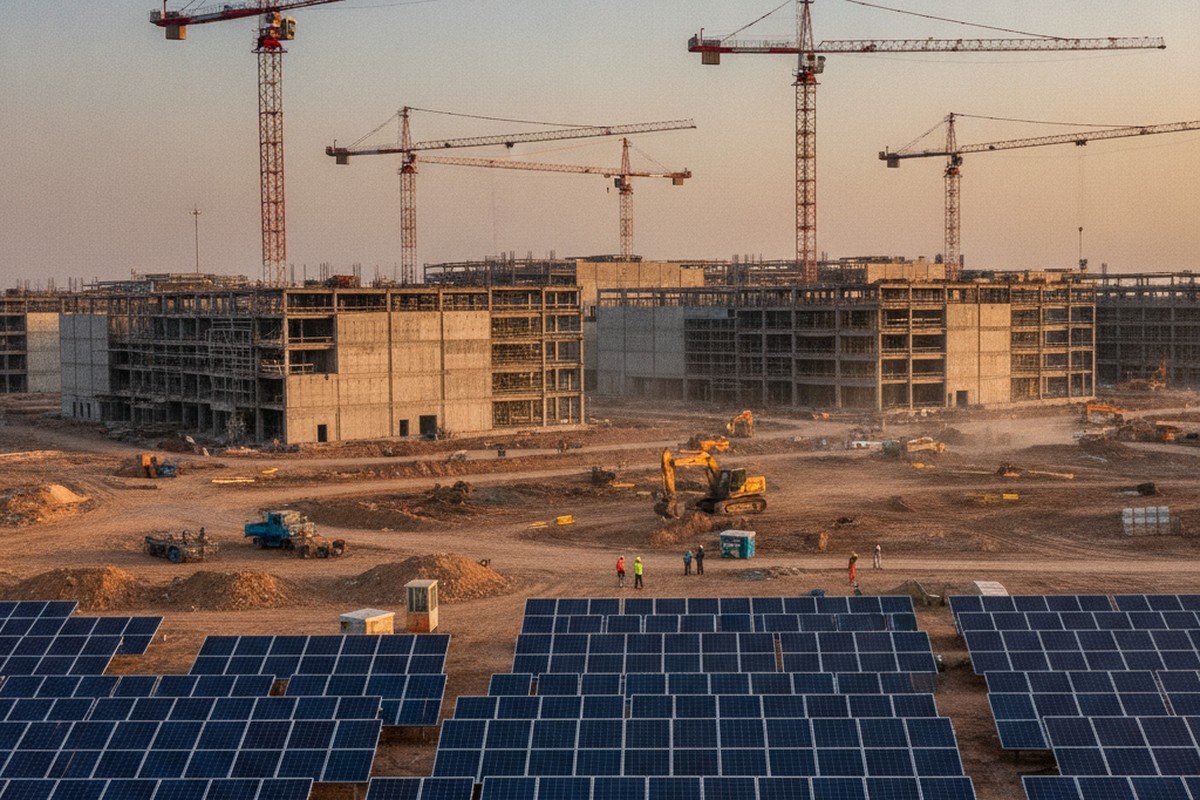
That fiscal architecture is a genuine advantage, largely immune to the accounting arguments unsettling US hyperscaler balance sheets, because it rests on tax certainty rather than vendor-financed demand projections. But it isn’t full insulation. Much of India’s physical capacity is precommitted campus space for the same global hyperscalers whose depreciation assumptions and circular deals are under scrutiny abroad, so a US-side reckoning that slows global AI capex stretches India’s build-out timelines even though the policy framework hasn’t changed. India’s captive global capability centres, which increasingly run AI infrastructure workloads for multinational parents, are typically among the first line items trimmed when a headquarters tightens spending, well before the parent’s own India-based data-centre plans are touched. Nor is India exempt from the resource side: data centres are projected to consume roughly 3 percent of the country’s electricity supply by 2030, and cooling-related water use is expected to more than double within five years, from around 150 billion to 358 billion litres. India has bought an unusually long runway of policy certainty, not immunity from a slowdown originating elsewhere in the loop.
The question that actually matters
The reckoning, if one comes, is unlikely to announce itself as a stock market crash first. It is far more likely to surface as an auditor pushing back on a useful-life assumption, an SEC comment letter asking a company to substantiate an AI demand claim made on an earnings call, or a board discovering, well after signing, that the compute commitment it approved was underwritten on assumptions nobody outside the vendor’s own investor relations team had independently tested. Every CEO who has recently signed, or is about to sign, a large AI infrastructure contract should worry less about whether the underlying demand is real and more about a narrower question: has anyone outside the deal checked how long the hardware underneath it is expected to last, and what happens to the contract’s economics if that number is wrong.