

Most CEOs see middle management as a cost to optimize away. If AI can handle routine decisions and coordination work, the thinking goes, why not flatten the hierarchy, redeploy the budget to AI infrastructure, and let the organization move faster with fewer layers between strategy and execution?
The answer is arriving in 2028, and it will be expensive.
The past two years have seen an aggressive wave of middle management elimination across enterprise technology, finance, and manufacturing. Amazon, Google, Meta, Oracle, Bayer have all cut substantial layers of management as part of their AI strategies. Cloudflare explicitly eliminated “measurers” (middle management and coordination functions) while retaining “builders,” achieving record revenue with 20% fewer people. On the surface, the math is compelling: streamlined decision-making, lower overhead, faster execution.
But this narrative obscures a far more consequential story. Companies are not actually choosing between middle management and AI. They are choosing between two different organizational designs, and they are making that choice on the basis of a misunderstanding about what middle managers actually do.
What Middle Managers Actually Do
The prevailing assumption about middle management work is wrong. The assumption is that middle managers spend their time in status meetings, data synthesis, and administrative coordination. That’s the 30 percent of their work that AI can increasingly automate. The remaining 70 percent—the work that actually drives organizational health and competitive advantage—involves judgment, complex problem-solving, talent development, and organizational change navigation.
Consider the evidence: Gartner projects that 20 percent of organizations will eliminate more than half their middle management roles by 2026. At the same time, Harvard Business Research shows that middle managers led 80 percent of successful organizational transformations, compared to only 20 percent of transformations led by senior executives alone. Middle managers also don’t appear to be vanishing from the economy: they comprised 13 percent of the US workforce in 2022, up from 9.2 percent in 1983, despite decades of automation and organizational flattening experiments in the 1990s and 2000s.
The contradiction points to a fundamental error in how companies are evaluating the middle management question. Organizations are looking at the routine work middle managers do—the work AI can already handle reasonably well—and concluding that middle managers are therefore unnecessary. They are ignoring the complex work that remains and for which no amount of automation creates organizational capacity.
The result is a structural problem that will not become visible until late 2026 or 2027, and will fully crystallize around 2028.

The 2028 Problem
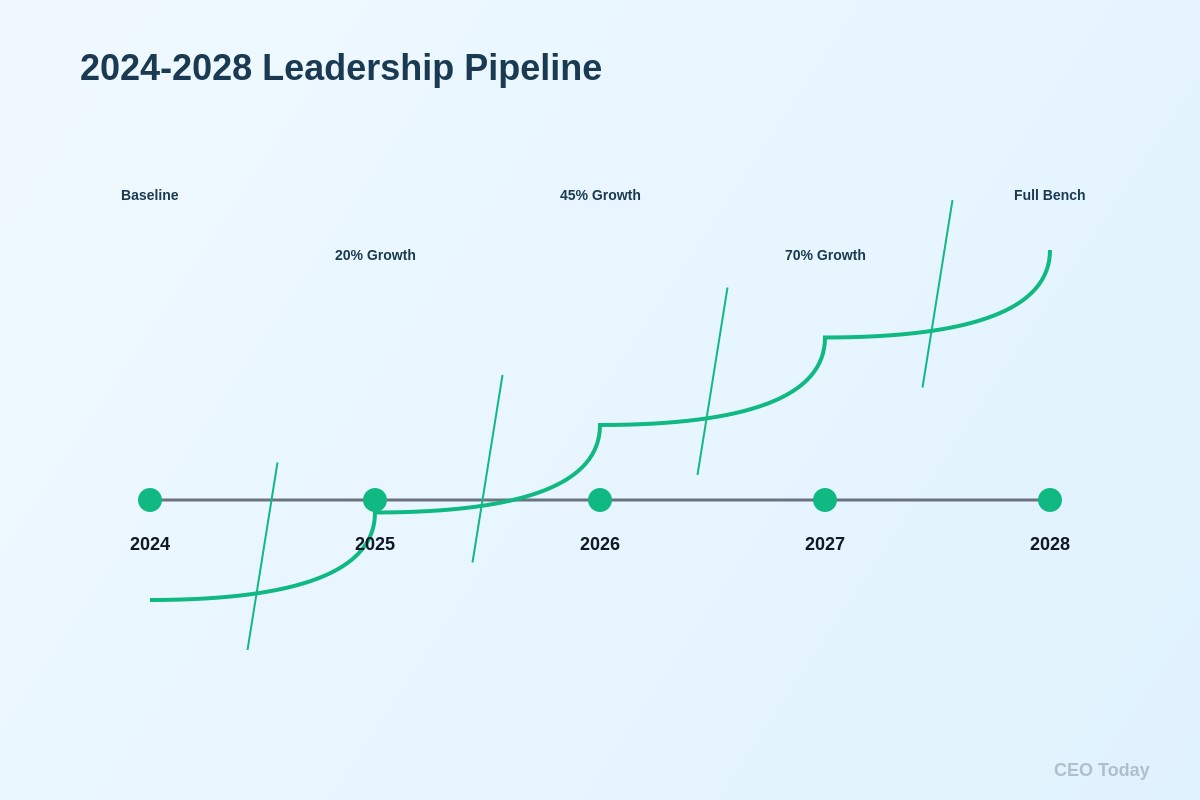
Two years after aggressive middle management cuts, companies consistently face a leadership pipeline crisis. The pattern, identified across multiple research sources tracking companies that reduced management layers, is remarkably consistent: cost savings of $2-3 million in the first year, followed by two years of relatively smooth operations, followed by a collapse in organizational capacity around year three.
The mechanics are simple. Middle managers are where organizational leadership develops. They are where individual contributors learn to navigate complexity, make judgment calls with incomplete information, think about strategy, and understand how organizations actually work. Remove this layer, and you remove the apprenticeship system for leadership. The immediate effect is cost savings. The downstream effect, arriving 2-3 years later, is a pipeline with no qualified internal candidates for director, VP, and senior leadership roles.
The consequence compounds. In 2028, companies that aggressively cut middle management will face simultaneous retirements and departures among their senior leadership while having no internal bench. They will be forced to hire leadership externally at significant premiums—executive search fees, sign-on bonuses, equity packages—at a moment when they are competing in a tight labor market with other companies facing the same problem. Moreover, externally hired leadership lack organizational context. They do not understand informal power structures, cultural history, or undocumented institutional knowledge. They perform the mechanical aspects of the role while struggling with what insiders grasp intuitively.
But the cost is not merely financial. Research from Newsweek and MIT, and from Deloitte, identifies what organizations actually lose when middle management layers disappear suddenly. They lose emotional intelligence in organizational communication. They lose early problem detection before issues escalate to crisis level. They lose the informal channels through which information flows upward. Most critically, they lose the protective function middle managers provide for experimental, long-term thinking. Alloy Partners research on innovation in flat organizations found that companies lose organizational capacity for transformational ventures when middle management is eliminated because experimental projects, lacking middle-management sponsorship and buffer protection through budget cycles, face immediate ROI pressure and get cancelled.
The organizations that are getting middle management redesign right—companies like Cloudflare, but also consultancies and technology companies running controlled experiments on organizational flattening—are not actually eliminating middle managers. They are fundamentally redesigning what middle managers do. They are moving them from coordination and information synthesis toward coaching, complex problem-solving, organizational change navigation, and hybrid human-AI workflow design. The managers who remain have fewer direct reports (widening manager-to-team ratios from 1:3 to 1:6, pushing some coordination work to AI and team structures) but more complex work, not simpler work. They are operating as what McKinsey and BCG call “player-coaches”—hands-on experts who oversee teams and complex projects rather than pure administrators.
This is a transformation, not an elimination. But it requires a completely different set of decisions than the ones most companies are currently making.
The Mistake
The fundamental mistake is treating middle management reduction as a cost-optimization problem rather than an organizational design problem.
Most companies, when they begin AI initiatives, ask the wrong question: “Which of our processes can AI automate?” If they ask this intelligently, they can identify routine work to delegate to AI—scheduling, data compilation, basic reporting, standard approvals. If they do this well, they can save money and free people to do higher-value work.
But then they ask a second question that poisons the whole strategy: “If AI can do all this routine work, why do we need middle managers to oversee it?” And because they cannot articulate a clear answer to this question—because they have not thought deeply about what middle managers actually contribute beyond routine coordination—they begin cutting management layers.
This is logical if, and only if, you believe middle managers primarily perform routine work. If you understand that middle managers are where judgment capacity gets built, where strategic thinking is developed, where innovation gets protected from short-term pressure, and where organizational culture gets maintained, then cutting middle management does not make sense. It makes sense only to maintain or reshape it.
The third decision, the one that separates companies that get this right from companies that do not, involves specificity. Which middle managers, which management layers, and which functions should be redesigned versus eliminated? At Cloudflare, the cuts were specific: eliminate the coordinators, eliminate the pure finance and compliance layers that do not drive strategy. Keep the builders, keep the hands-on engineering leaders. At Amazon, the CEO memo was about manager-to-team ratios, not headcount; the goal was to push more decisions to teams while keeping management structure intact. At Meta and Google, the cuts were broader and less clearly strategic—which is why both companies now face organizational challenges they did not anticipate.
What CEOs Should Be Asking
For boards and CEOs, the intelligence question is whether management layers are being eliminated strategically or reactively. There is a massive difference between a deliberate redesign of middle management (which might or might not include elimination of some roles) and reactive cost-cutting disguised as digital transformation.
The strategic questions sound like this: Which middle management work is genuinely being automated by AI, and which work is just being made invisible? Are we building new organizational capacity for the judgment-intensive work that remains, or are we just pushing that work onto senior leaders and individual contributors without support? Do we have a clear succession plan for where our next generation of leaders will come from—and does it account for the fact that we just eliminated the apprenticeship system where they would have learned? What is the timeline for feeling the consequences, and have we hedged against the 2028 pipeline crisis by beginning to develop high-potential individual contributors now?
The uncomfortable organizational truth is that flat structures do move faster at first. They do reduce overhead. But they do not scale indefinitely, and they do not generate the internal bench strength that keeps organizations adaptable over decades. The companies that have successfully managed this—the ones combining AI automation with middle management transformation rather than elimination—are the ones that asked hardest questions about what would break if they removed the layer.
For CEOs currently celebrating middle management cuts as signs of modernization, the measure of success is not this year’s cost savings. It is whether, in 2028, you have qualified internal leaders ready to step into director and VP roles, whether your organization has retained its capacity for complex problem-solving and change navigation, and whether you avoided the external hiring crisis and cultural degradation that flat organizations eventually face.
The AI boom is real. The opportunity to optimize middle management work is real. But the opportunity to mistake efficiency for strategy, and to confuse short-term cost reduction with long-term organizational strength, is just as real. The CEOs who win are the ones who understand the difference.