

For two years, every earnings call in the AI economy has circled the same anxiety: not enough chips. Nvidia’s backlog, TSMC’s capacity, the scramble for H100s and now Blackwell racks — this was the bottleneck story CEOs learned to repeat at board meetings. It was never wrong, exactly. It’s just becoming outdated. The binding constraint on how much AI infrastructure a company can build has quietly shifted upstream, from the chip to the socket. You can now buy all the GPUs your balance sheet allows and still be unable to switch them on, because there is nowhere left on the grid to plug them in.
That is not a metaphor. In large stretches of the US grid operated by PJM Interconnection, which covers thirteen states from Illinois to Virginia, more than 800 new generation projects totalling roughly 220 gigawatts entered the queue when it reopened in April 2026 — and PJM’s best-case estimate is one to two years just to complete the technical review, before a shovel goes into the ground. The International Energy Agency expects global data-centre electricity consumption to roughly double from 415 terawatt-hours in 2024 to 945 terawatt-hours by 2030. Goldman Sachs has put the increase in data-centre power demand as high as 165-220% over the same window. None of that is speculative AI hype; it is what happens when an industry that used to need warehouses now needs the electrical output of a mid-sized country.
Why hyperscalers are becoming power companies
The response from the largest AI buyers has been to stop waiting for utilities and start behaving like one. Microsoft has committed roughly $16 billion over twenty years to bring Three Mile Island’s undamaged reactor back online with Constellation Energy, specifically to feed a data-centre campus. Amazon has taken a stake in X-energy’s small modular reactor programme in Washington state and separately committed more than $20 billion to the Talen Energy nuclear campus in Pennsylvania. Google has signed a 500-megawatt deal with Kairos Power for a fleet of next-generation reactors. Meta’s contracted nuclear portfolio, through TerraPower, Oklo and existing plants, now runs to several gigawatts, with delivery dates stretching into the mid-2030s. These are not corporate sustainability gestures. They are twenty-year capital commitments, the kind previously made only by utilities and sovereign wealth funds, and they are being signed by companies whose core competency was, until recently, software.
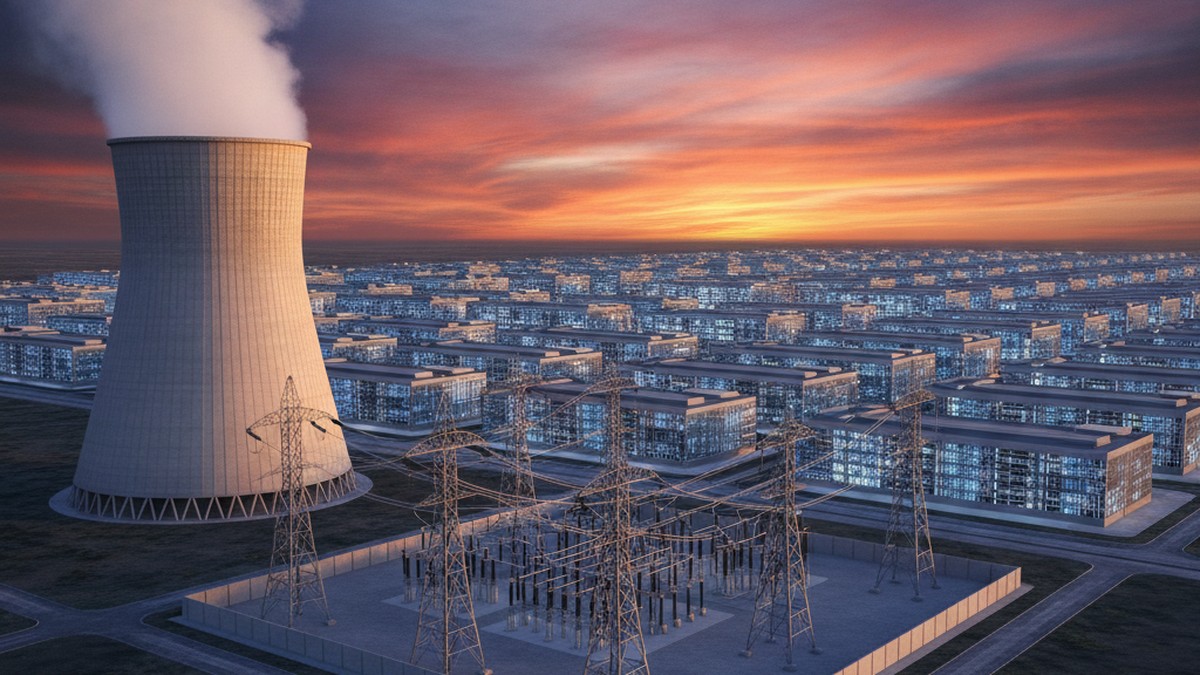
This is the part boards outside the hyperscaler tier are underpricing: the contest for AI advantage is no longer primarily about who has the best model or even the most chips. It is about who locked in gigawatts of firm power, and grid interconnection rights, before everyone else worked out that these were the scarce asset. A signed power purchase agreement with a nuclear operator, or a place at the front of an interconnection queue, is becoming what spectrum licences were to telecoms in the 1990s and water rights were to agriculture in the American West — a position, taken early, that is nearly impossible for a later entrant to replicate at any price. Companies without the balance sheet or credit rating to sign a two-decade power contract will not be competing to build frontier AI infrastructure themselves. They will be renting compute from the handful of firms that got there first, on terms those firms set.
The liability nobody is stress-testing
There is a financial asymmetry here that deserves more board-level attention than it is getting. A GPU cluster is, however painfully, a depreciating and in principle resellable asset — you can idle it, repurpose it, write it down. A twenty-year power purchase agreement or a nuclear restart commitment is not something you quietly unwind if AI demand disappoints or monetisation falls short of the capex it was meant to justify. It is a fixed, long-duration liability layered directly on top of an already aggressive compute buildout, and it assumes today’s demand trajectory holds for a horizon longer than most strategic plans even attempt to forecast. That correlation — betting the balance sheet on both the chips and the electrons that power them, on the same optimistic curve — is a risk concentration that doesn’t show up cleanly in a single capex line, and it is precisely the kind of thing that looks fine until the cycle turns.
The second, less-discussed risk is political. Faced with permitting delays, some AI developers have simply gone around the grid entirely. xAI’s Memphis data centre ran dozens of gas turbines, reportedly without the air permits normally required, drawing a lawsuit from the Southern Environmental Law Center and a wave of local opposition over noise and emissions — a preview of the friction “behind-the-meter” power strategies are likely to generate as they scale. Meanwhile, ordinary electricity ratepayers are starting to notice who is driving up their bills: a Bloomberg analysis found wholesale power costs rising as much as 267% year-on-year in regions with heavy data-centre load. Oregon and Georgia have already passed rules forcing data centres to absorb their own grid costs rather than spreading them across residential customers; Delaware, Florida, Maryland and Oklahoma have similar bills moving through legislatures. This is the early shape of a social-licence problem AI companies have not had to manage before — closer to what fracking operators or big agribusiness faced over water than anything in software’s history. A model can’t generate the kind of local political backlash that a noisy, unpermitted gas plant next to a residential subdivision can.
India’s version of the same equation
India is running headlong into this same constraint, on its own terms. The country’s live data-centre capacity has roughly quadrupled over six years to about 1.7 gigawatts, with another 1.3 gigawatts under construction and over 3 gigawatts of projects already holding secured land, power and permits — Maharashtra alone accounts for more than half the total. Reliance and Adani have between them committed roughly $210 billion toward this build-out, dwarfing the roughly $84 billion pledged by Google, Amazon and Microsoft combined, and nearly all of it is aimed at hyperscale AI campuses rather than conventional enterprise hosting. BloombergNEF projects India’s data-centre electricity demand will grow more than eightfold, from 11 terawatt-hours in 2025 to 91 terawatt-hours by 2035.
The gap that matters is the same one showing up in the US: transmission capacity is being built more slowly than generation capacity, and several of the states courting hyperscale campuses — including Tamil Nadu and Karnataka, both drawing serious investment — already run water-stressed cities where a single large data centre’s cooling load is a legitimate civic issue, not a rounding error. India’s financially fragile state electricity distribution companies are in a weaker position than PJM to simply absorb a sudden multi-gigawatt industrial customer without passing costs somewhere. Delhi’s parallel push to open small modular reactor development to private capital is the same instinct driving Microsoft and Amazon toward nuclear — recognition that firm, dispatchable power, not renewable capacity on paper, is what an AI campus actually needs around the clock. Handled well, this could make India one of the more credible alternative sites for global AI compute over the next decade. Handled the way parts of the US have handled it, it could import the same ratepayer resentment and permitting gridlock years ahead of schedule.
What this means for the executives who aren’t hyperscalers
For the overwhelming majority of CEOs, none of this means signing a nuclear PPA. It means recognising that the AI capability their organisation can access over the next five years will be shaped less by which model providers they choose and more by which of those providers actually secured the power to run at scale. It means asking cloud and AI vendors a question procurement teams have never had to ask before: not just what compute they’ve reserved, but what electrons back it, and how much of that supply is contracted rather than assumed. And it means understanding that the moat being built right now isn’t algorithmic. It is showing up in twenty-year contracts, in rural county interconnection filings, and in state legislatures deciding who pays for it — largely outside the view of executives still benchmarking each other on model performance.