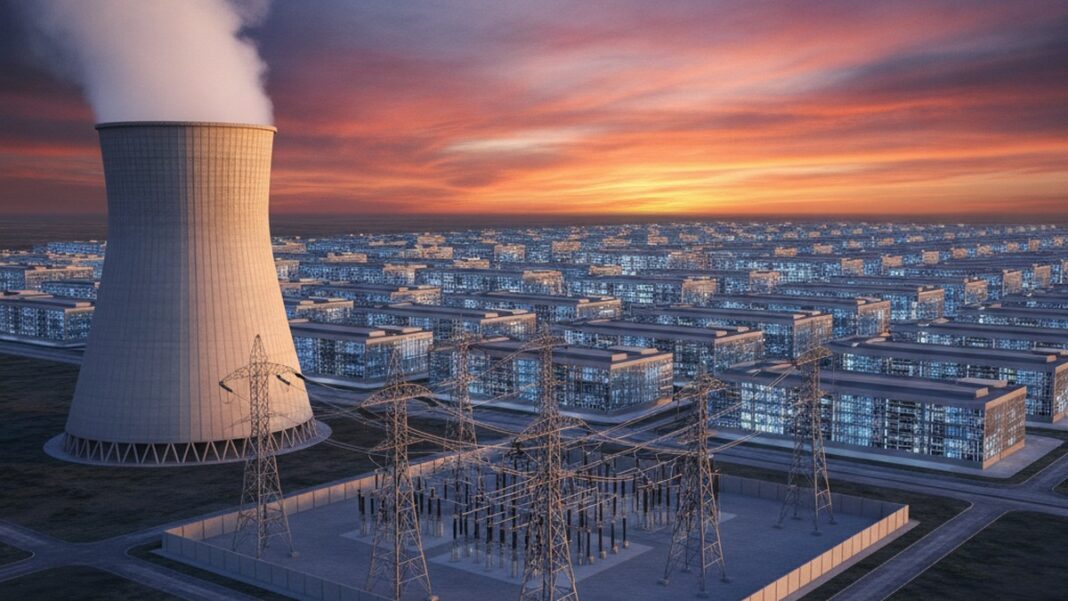

Every board that has approved an AI infrastructure commitment in the past eighteen months has, in some form, run the power math: gigawatts required, grid interconnection queues, the premium for firm renewable capacity, the multi-year wait for gas turbines. Utilities have become boardroom vocabulary. Chief financial officers now know the difference between a power purchase agreement and a co-located generation deal. That literacy was earned the hard way, through blown timelines and re-priced contracts.
What almost none of that diligence has covered is water. And water, unlike electrons, cannot be shipped in from three states away when the local supply runs short.
The numbers are not marginal. U.S. data centers directly consumed an estimated 17.4 billion gallons of water for cooling in 2023, according to the Information Technology and Innovation Foundation, but that understates the real exposure roughly twelvefold once you count the water used to generate the electricity those facilities draw: close to 211 billion gallons a year, embedded invisibly in the grid mix. Morgan Stanley’s research desk projects global AI data center water consumption rising from roughly 130-190 billion litres in 2024 to somewhere between 637 and 1,485 billion litres by 2028, an elevenfold increase in four years. Power capacity plans get revised in investor decks every quarter. Water plans, in most jurisdictions, do not exist as a disclosed line item at all.
That asymmetry is the story. Capital has spent two years learning to underwrite electrons; it has not yet learned to underwrite water, and the two resources fail on different timelines, in different places, with different political consequences.
Why power and water are not the same problem
Power shortages are, broadly, solvable with money and time: build a gas peaker plant, sign a longer PPA, pay a premium for grid priority, or relocate a training cluster to a jurisdiction with spare transmission capacity. Water is a more rigid constraint. A watershed does not expand because a hyperscaler is willing to pay more for it. As Matthias Sprenger, a hydrologist at North Carolina State University who has studied the sector’s footprint, puts it: “A large, continuous industrial user, like a data center, fundamentally alters a watershed because its water demand never sleeps.” Servers need cooling around the clock, in wet years and dry ones alike; agriculture, drinking-water utilities and ecosystems do not get to negotiate around that inflexibility.
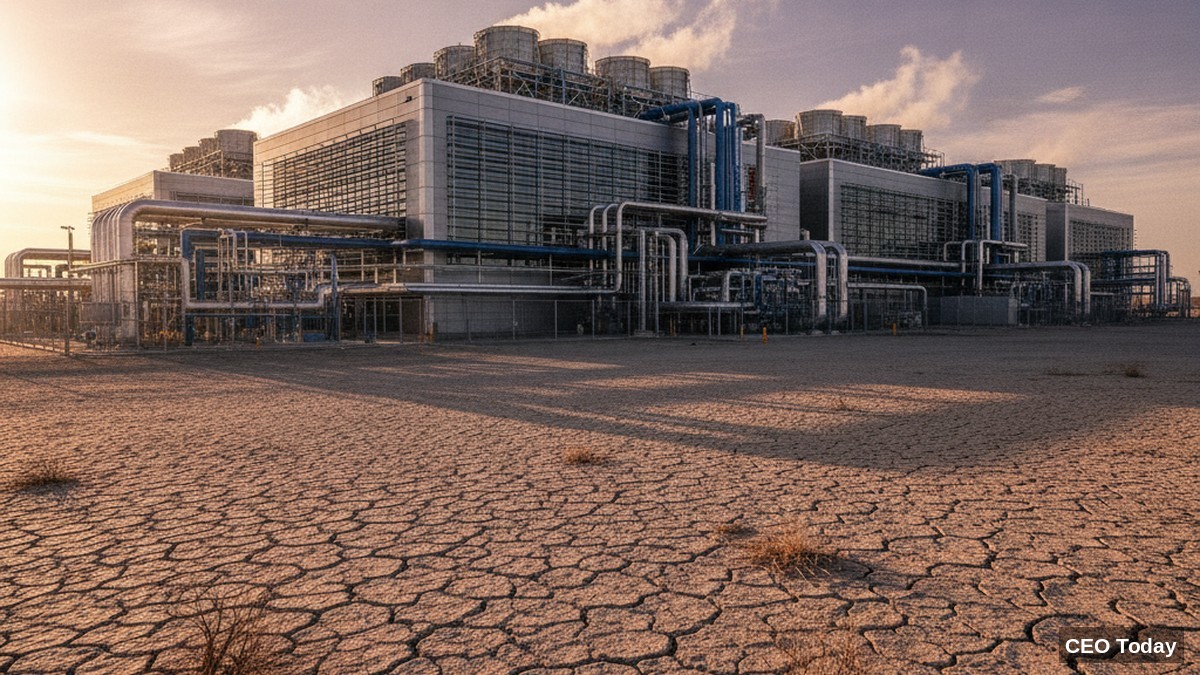
The clearest evidence of what happens when this collides with reality is playing out in California’s Imperial Valley, where a 330-megawatt facility requiring an estimated 287 million gallons of water a year was denied access to Colorado River supply by the Imperial Irrigation District, the public agency that allocates it. The developer is now suing, arguing there is no rational basis for refusing industrial reallocation when agricultural users routinely combine water rights for large projects. The case is unresolved, but the arithmetic behind it is not: agriculture already consumes close to 80% of California’s Colorado River allocation, the river itself is a stressed source supporting roughly 40 million people across seven states, and a single facility was asking for an amount local officials judged the system could not absorb without displacing someone else’s claim.
This is no longer a niche dispute. On September 8, Massachusetts governor Maura Healey signed an executive order barring state permits for data centers above 25 megawatts unless developers secure local community approval, sign a community benefits agreement, and demonstrate compliance with water quality and wastewater standards — an explicit acknowledgment that resource and permitting risk, not just electricity cost, now sits on the critical path for siting decisions. Westfield and Lowell have already imposed one-year moratoriums; Holyoke has banned new facilities outright. Over 200 state-level bills addressing data centers were introduced across the U.S. in 2025, with more than 40 enacted. Executives who treat this as a slow-moving regulatory backdrop are underestimating how quickly local political consent, not federal policy, has become the binding constraint on where AI infrastructure can actually be built.
India’s version of the problem is arriving faster, not slower
If the American story is about political consent catching up with an already-built base, India’s is about a buildout racing ahead of any resource assessment at all. The country’s data center capacity stood at roughly 1.5 gigawatts at the end of 2025; Deloitte projects 8 to 10 gigawatts by 2030, a six-to-sevenfold expansion inside five years, backed by commitments including Reliance’s roughly $110 billion, seven-year plan centred on Jamnagar and Adani’s parallel $100 billion push built around partnerships with Google and Microsoft. Both frame their buildouts around renewable power; neither, in public terms, addresses water with anything like the same specificity.
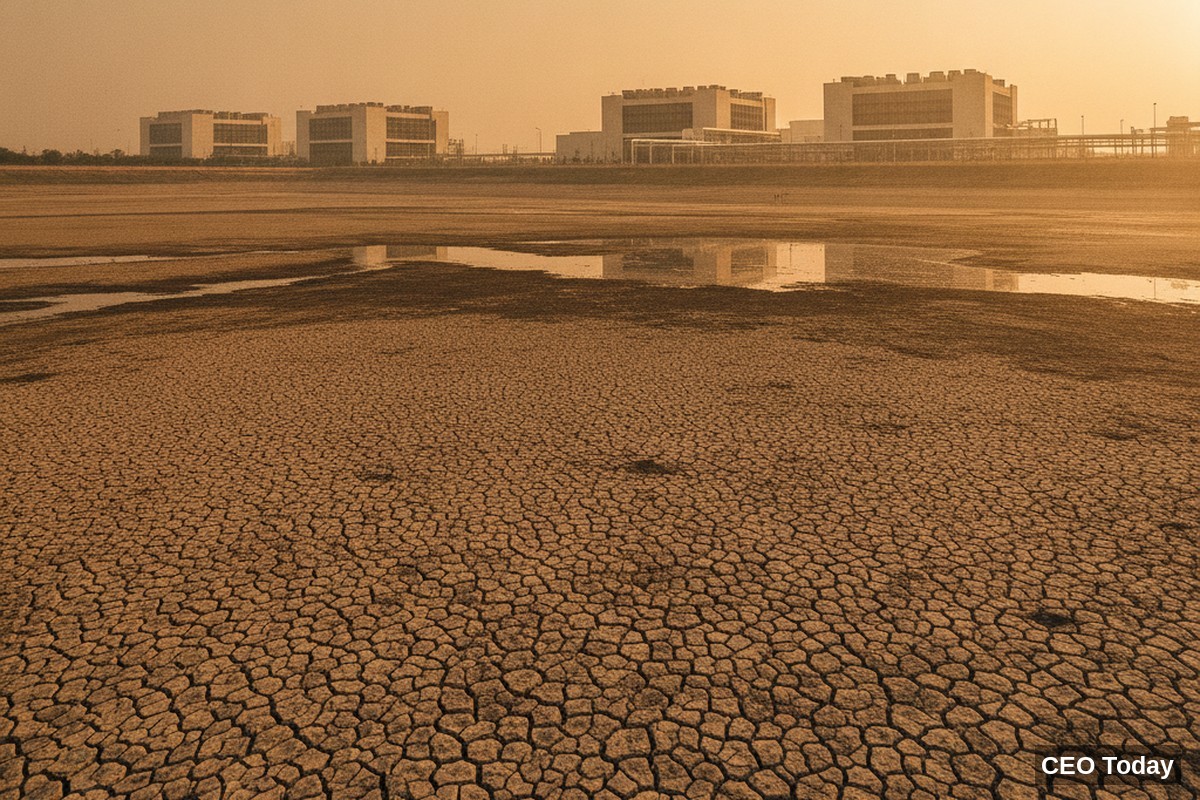
That gap matters because of where the capacity is landing. Karnataka’s IT minister, Priyank Kharge, has put a concrete figure on consumption: roughly 25 million litres of water per megawatt per year, which on India’s current 1.5-gigawatt base implies something on the order of 37.5 billion litres annually from data centers alone, with an estimated 80% of that lost to evaporation rather than returned to the local water cycle. Roughly 75% of India’s data centers sit in regions already classified as water-stressed. Hyderabad, one of the country’s fastest-growing hubs, is projected to face an 870-million-litre-per-day deficit by 2027. Bengaluru is already extracting close to ten times what its aquifers recharge annually. This expansion is accelerating into a monsoon outlook that is, if anything, worsening: the India Meteorological Department’s 2026 forecast of 92% of the long-period average is the weakest opening forecast in 25 years, with NOAA putting the odds of an El Niño pattern through June-August at 62%, a pattern historically associated with weaker Indian monsoons.
The regulatory architecture has not caught up. No Indian state’s data center policy currently mandates water-stress mapping before approval, or a thermal impact assessment, despite University of Cambridge research from March 2026 finding that data center operations raise surrounding land surface temperatures by an average of 2.07°C, with measurable effects extending up to ten kilometres. Because facilities are classified as IT/ITeS rather than industrial users, they largely bypass the environmental impact assessment framework that would apply to a comparable manufacturing plant, and there is no standing disclosure requirement for how much water any given facility withdraws. Karnataka’s 2015 rule requiring thermal power plants to use treated rather than freshwater is the one workable precedent researchers point to, but it has not been extended to the sector it was arguably written to anticipate.
The accounting trick that hides the real exposure
Big technology operators have not ignored the issue; they have mostly reframed it. Microsoft says its newest facilities use roughly 90% less water than its earliest designs and claims to have hit its “water positive” commitment, replenishing more than it consumes, five years ahead of its original 2030 target. Google has made a comparable pledge. Both claims are directionally real: dry cooling, liquid-to-chip systems and immersion cooling genuinely can cut water use by more than 90% relative to legacy evaporative designs, and the technology to build near-zero-water facilities exists today.
The trouble is what “water positive” measures. It is typically a global, portfolio-level balance: replenishment credits funded in one watershed can offset consumption in an entirely different one, sometimes on a different continent. A company can be aggregately water positive while a specific facility in Bengaluru, Phoenix or Imperial Valley is still drawing hard on a stressed local aquifer with no access to that offsetting credit. For a CEO evaluating site-selection risk, or a board assessing an infrastructure partner, the published sustainability metric is close to useless as a predictor of local exposure. The number that matters is the one almost nobody discloses: withdrawal at the individual facility, against the carrying capacity of its specific watershed, in the year local rainfall underperforms.
What this means for anyone underwriting AI infrastructure now
The practical implication is that water risk needs modeling the way currency or interest-rate risk already are: not an ESG appendix, but a line item that can independently kill a project’s economics or timeline, regardless of how solved the power question looks. Site-selection diligence built purely around interconnection queues and renewable power availability is now demonstrably incomplete; Massachusetts and Imperial Valley both show a facility can have its power arranged and still be unbuildable. For investors backing India’s buildout specifically, the absence of mandatory disclosure is not evidence of low risk; it is evidence of unpriced risk, in a market where the marginal buyer of infrastructure capital has been treating renewable power credentials as the whole underwriting story.
The companies that get ahead of this will not be the ones with the most convincing global sustainability report. They will be the ones that can show, facility by facility, exactly what they draw and what the local system can absorb in a bad year. That is a harder number to produce, and a far more honest one than any aggregate pledge currently on offer.