

In the same fortnight this year, two sets of earnings calls told opposite stories about artificial intelligence. Microsoft, Meta, Amazon and Alphabet told investors they would collectively spend somewhere north of $700 billion on AI infrastructure in 2026 — a number so large that Big Tech’s combined capital expenditure now exceeds the GDP of most countries in the G20’s lower half. In the same window, Tata Consultancy Services reported a rare revenue decline, HCLTech warned its own management that revenue could fall three to five percent over the coming year, and Wipro’s finance chief acknowledged compressed margins on new deals. The word one Indian IT leader used to describe the outlook was blunt: degrowth.
Both stories are about the same technology. Neither company is lying about its numbers. And that, for any CEO trying to set an AI strategy in 2026, is the uncomfortable part. If spending more on AI is supposed to build advantage, and losing revenue to AI is supposed to be a sign that adoption is working as designed, then capital expenditure has stopped functioning as a reliable signal of anything. It has become noise dressed as strategy.
The assumption boards stopped questioning
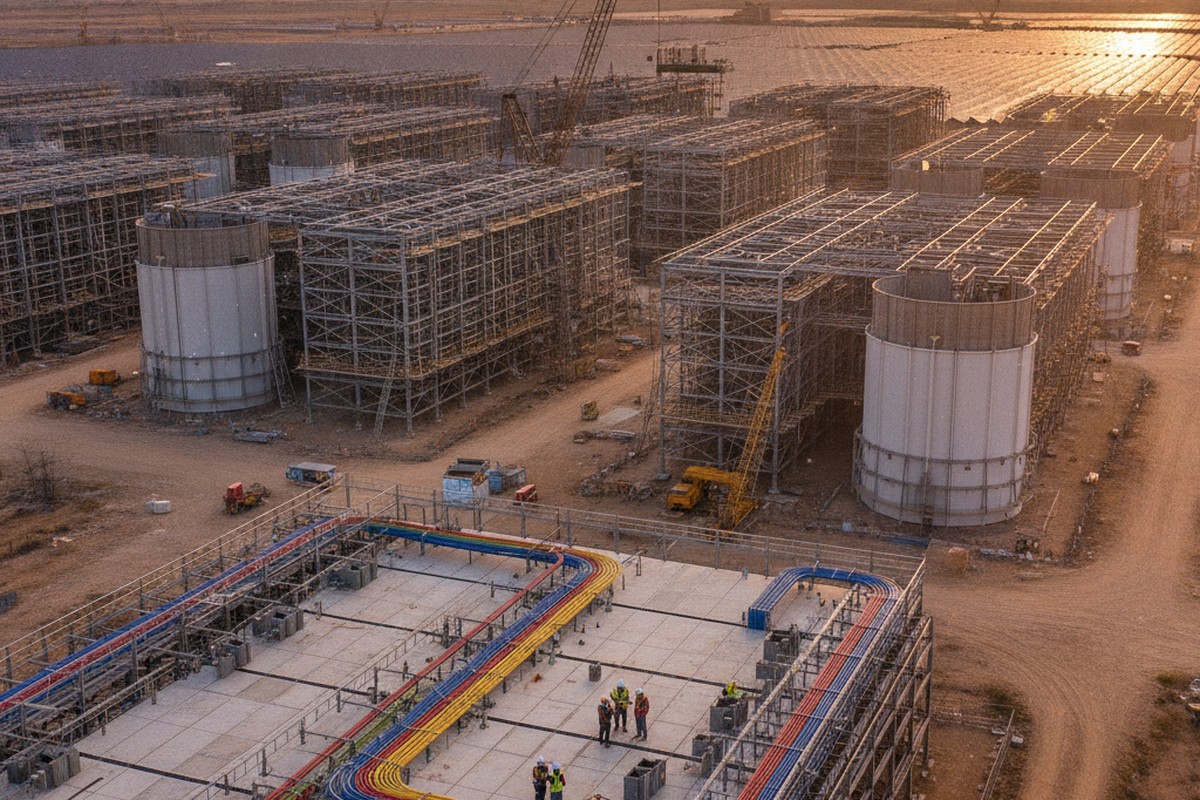
The working theory inside most boardrooms since 2023 has been simple enough to fit on a slide: whoever controls the most compute, the best models and the largest AI budget will win their industry. It is a theory borrowed, more or less intact, from the cloud computing era, when scale genuinely was destiny. It has produced a capex race with few precedents — Statista and multiple bank research desks now put combined 2026 AI infrastructure spending across the four largest hyperscalers at roughly $725–760 billion, up from around $400 billion two years earlier. Reliance Industries has committed $110 billion over seven years to build gigawatt-scale AI data centre capacity in Gujarat, backed by its own surplus solar power. Adani Group has pledged $100 billion of its own, with a further $150 billion expected to flow into the surrounding ecosystem. India, in other words, has decided to bet at hyperscaler scale on exactly the same assumption Silicon Valley is now starting to interrogate.
That assumption is showing cracks. A widely cited MIT study published last year — based on interviews with 52 executives, a survey of 153 business leaders and analysis of roughly 300 public AI deployments — found that 95 percent of generative AI pilots produced no measurable impact on profit or loss, despite an estimated $30–40 billion in enterprise spending behind them. The failure wasn’t evenly distributed. Large enterprises led every other segment in the number of pilots launched and lagged nearly all of them in successful deployment. Budgets skewed toward sales and marketing use cases, which is where the demos look best, even though the study found stronger returns sitting in back-office functions such as procurement, document processing and risk review. And tools built in-house succeeded at roughly half the rate of ones bought from vendors who had already done the hard work of embedding AI into an actual workflow rather than bolting a chatbot onto one.
None of this means AI doesn’t work. It means the variable that determines whether it works has almost nothing to do with how much a company spends, and almost everything to do with whether the organisation redesigned a decision or a process around it. That is a much less comfortable finding for a CEO than “spend more,” because it can’t be solved by writing a bigger cheque. It requires rethinking who in the organisation actually makes a given decision today, and whether that person, team or approval chain still makes sense once a model can do the first draft of the work in seconds.
The debt nobody is being shown
The capex race has also produced a financing structure that deserves more board-level scrutiny than it currently gets. According to the Bank for International Settlements, hyperscalers issued more than $100 billion in corporate bonds in 2025 alone to fund AI infrastructure, and credit spreads on the more leveraged among them have already begun to widen. But a growing share of the real exposure now sits off balance sheet entirely, inside joint ventures and special-purpose vehicles that acquire or build data centres, financed by a mix of private equity, private credit and long-term capacity or lease commitments from the hyperscaler itself. The BIS’s own description is worth sitting with: these arrangements are “economically akin to debt” while “largely residing outside corporate balance sheets,” creating obligations that substitute a large upfront capital cost for a long tail of operating expense — precisely the kind of structure that made off-balance-sheet leverage so difficult to see coming in past credit cycles.
Layered on top of that is a web of supplier financing that has drawn its own scrutiny: Nvidia’s roughly $100 billion investment commitment into OpenAI, a $300 billion compute agreement between OpenAI and Oracle, tens of billions in chip commitments between OpenAI and AMD that also made OpenAI a significant AMD shareholder, and expanding multi-billion-dollar contracts between OpenAI and CoreWeave. Paul Krugman has called the resulting pattern a “financial ouroboros,” in which money increasingly circulates among a small cluster of companies rather than arriving from external customers. Others, including economist-blogger Noah Smith, argue this is closer to conventional vendor financing — the same logic General Motors uses to finance its own car buyers — and that Nvidia’s balance sheet strength makes the lending rational rather than desperate. Both readings can be partly true at once. Vendor financing is not fraud. But it is also, by definition, a sign that a supplier has concluded it needs to fund its own demand — which is not the position a company occupies when demand is simply there for the taking.
India’s double exposure
What makes this moment genuinely distinctive for Indian business leaders is that the country is exposed to both sides of the same mispricing simultaneously, in a way few other economies are. On the supply side, Reliance and Adani are underwriting a $200-billion-plus bet that India becomes a cost-competitive global compute hub, riding the same capex logic now being questioned in Redmond and Mountain View. On the demand side, the companies most directly exposed to AI’s actual productivity effect — India’s IT services majors — are discovering that agentic AI does not create a new market for them so much as it quietly deletes the old one. The industry’s core business model, billing largely by the hour for skilled labour, assumes that software delivery requires a predictable multiple of human effort. Agentic AI breaks that multiple, and it is breaking it faster than sales teams can renegotiate contracts into outcome-based pricing that captures the value AI creates instead of simply giving the savings back to the client.

That is not an argument against either bet. Compute capacity that comes online in 2027 and 2028 may well be underpriced by the standards of 2030, and Indian services firms that move fastest to outcome-based and platform-based pricing may end up better positioned than competitors clinging to headcount-linked revenue. But it does mean an Indian conglomerate board approving a data-centre commitment and an IT services board approving a pricing strategy are, in effect, making the same underlying judgment about how quickly AI-driven productivity translates into durable revenue — and very few boards on either side are modelling that judgment explicitly, or comparing notes with each other.
What CEOs should actually be asking
The practical implication is not that AI spending is wasted, or that the skeptics are right and the capex boom is a bubble waiting to pop. It is that capital deployed and capital returned have become two separate storylines, and most executive reporting still treats them as one. A board that receives a capex update on AI infrastructure and a separate operational update on AI adoption, reviewed by different committees on different timetables, is structurally unable to see whether the company is compounding advantage or compounding exposure.
The more useful question for 2026 is not “are we spending enough on AI” but “which of our decision rights, pricing models and cost structures does AI make obsolete regardless of what we spend” — and whether the organisation has a mechanism for finding that out before the balance sheet does. The MIT data suggests the answer lies less in procurement budgets than in a willingness to redesign process ownership; the BIS data suggests the debt behind the industry’s infrastructure is more real, and less visible, than most capex slides imply. Executives who conflate the two are optimising for a number that no longer means what it used to.