

On January 1, 2026, the European Union’s Carbon Border Adjustment Mechanism quietly entered what Brussels calls its “definitive regime.” No ribbon-cutting, no market panic, barely a headline outside trade-policy circles. Most executives who track CBAM at all treat it as a compliance deadline that has already been absorbed into the cost base: a new line item for steel, aluminium, cement, fertiliser and hydrogen exporters, priced, provisioned for, and largely settled by the India-EU free trade agreement concluded in the same window. That reading is comfortable, and it is also incomplete in a way that will matter a great deal to how capital gets allocated in heavy industry over the next decade.
CBAM is not a tariff in the way a 25 percent steel duty is a tariff. A tariff taxes a category of goods, uniformly, regardless of who made them or how. CBAM taxes a gap: the difference between the actual embedded carbon emissions of a specific consignment from a specific plant, and the benchmark emissions intensity assumed under the EU’s own Emissions Trading System. That distinction sounds technical. It is actually the whole story, because it means CBAM does not discriminate between countries so much as it discriminates within them, plant by plant, furnace by furnace, against a moving EU carbon price rather than a fixed schedule. A country is not “hit” by CBAM. Individual assets are, according to how they were built and powered.
What the compliance-cost framing misses
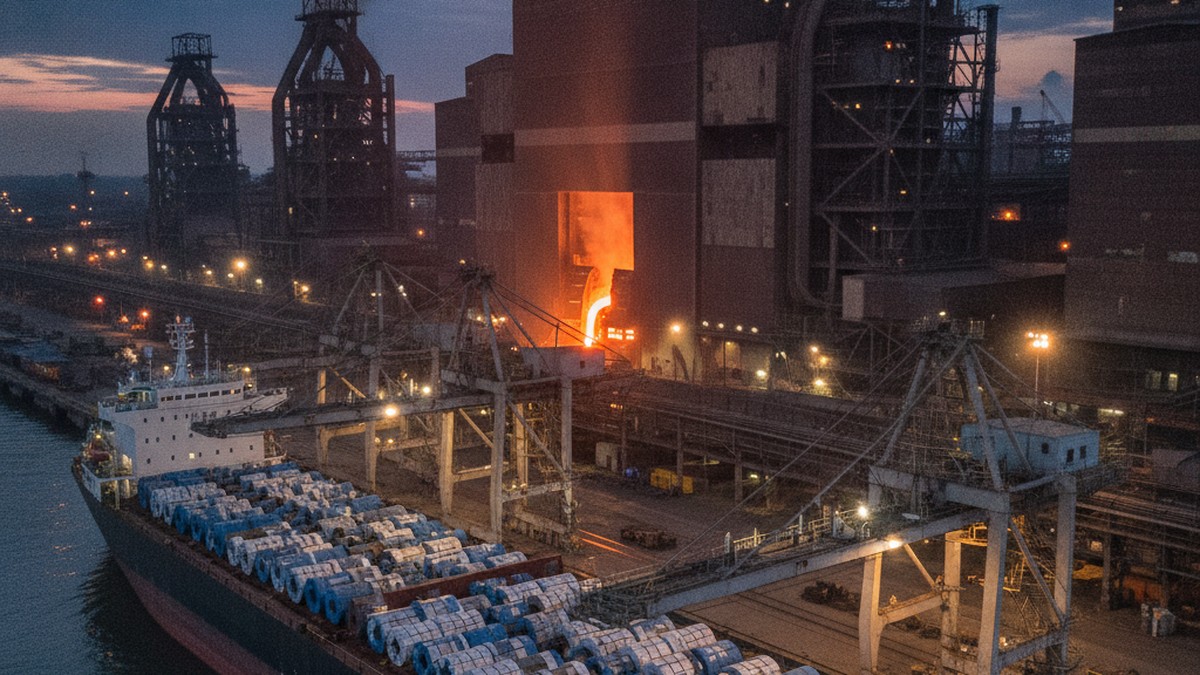
The headline numbers are real enough. Iron and steel account for roughly 90 percent of India’s CBAM-exposed exports to the EU, and industry estimates put annual compliance costs for hard-to-abate Indian sectors at $2 billion to $4 billion once certificate purchases begin. Steel and aluminium shipments to the EU have already softened, from roughly $7 billion to an average of $5.8 billion in FY2024-25, according to trade figures cited by Indian lawmakers, as exporters and buyers adjusted ahead of the mechanism taking effect. New Delhi’s official position has been unambiguous: CBAM has been described by government spokespeople as discriminatory, protectionist, and inconsistent with both World Trade Organization rules and the Paris Agreement’s principle of common but differentiated responsibility.
All of that is a reasonable basis for a defensive posture. It is a poor basis for a strategic one, and the gap between the two is where boardroom thinking is currently stuck.
Start with what the “resolution” via the EU-India free trade agreement, finalised in early 2026 and pitched domestically as the “mother of all deals,” actually contains. Indian negotiators secured a most-favoured-treatment style commitment that any flexibility the EU extends to other trading partners on CBAM would automatically extend to India, alongside a Green Hydrogen Task Force, roughly €500 million in green transition assistance over two years, and a €2 billion European Investment Bank facility for climate-resilient infrastructure. That is a meaningful diplomatic outcome. It is not, on the EU’s own account, an exemption. The European Commission has stated plainly that there is no commitment to change CBAM obligations or grant India preferential treatment under the mechanism; what exists instead is a “technical dialogue” beginning this year, with no formal simplifications yet notified. Two things can be true at once: the FTA is a genuine win on market access and finance, and CBAM itself remains, structurally, untouched. Executives briefed on the deal in political terms rather than mechanism terms are the ones most likely to be caught out.
There is a second, more consequential piece of fine print. A late-2025 “Omnibus” simplification of CBAM raised the small-importer exemption threshold and pushed the actual purchase and surrender of carbon certificates to February 2027, covering emissions embedded in 2026 imports. That has been widely read, including inside Indian industry, as a reprieve. It is better understood as a deferral with a ticking clock: the obligation to declare embedded emissions started this year regardless, the liability is accruing now for accounting purposes, and the runway that looks like relief is really the last stretch in which a plant’s 2026 emissions profile becomes financially, not just reputationally, permanent.
The sorting effect nobody is pricing
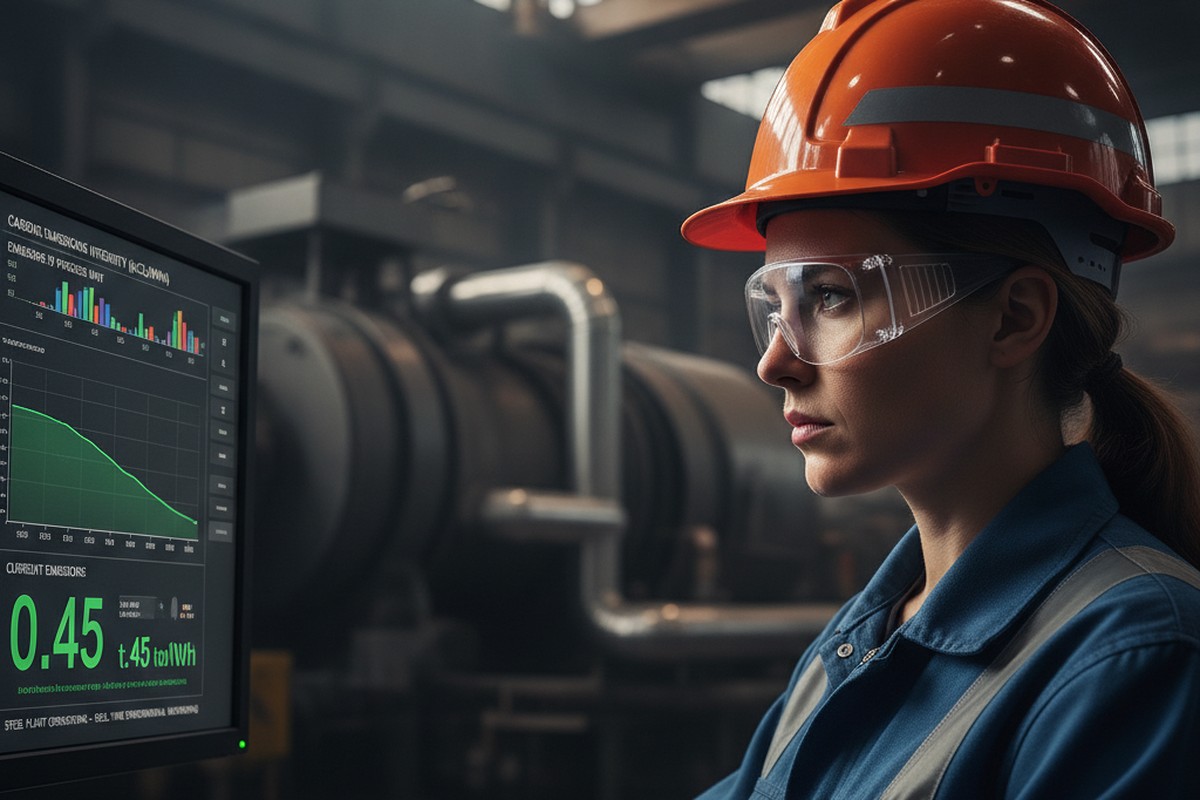
Here is the part of the story that gets lost in the compliance framing. An analysis by the climate think tank Sandbag modelled India’s aggregate CBAM cost falling sharply, from roughly €762 million to around €79 million, as EU carbon prices normalise and Indian output shifts toward lower-emission capacity. More strikingly, the same analysis found that under an ambitious decarbonisation trajectory, India’s steel sector could move from a net cost position to a net profit of roughly €44 million under CBAM, because efficient, low-emission facilities earn a relative advantage against the EU benchmark rather than simply avoiding a penalty. ArcelorMittal Nippon Steel’s Hazira plant, with emissions intensity already close to EU benchmark levels, was cited as a facility positioned to gain rather than lose from the mechanism as currently designed.
That is not a rounding error in the compliance model. It is evidence that CBAM’s real function is to reallocate competitive advantage inside carbon-intensive industries, not to tax a country’s exports as a bloc. Two Indian steel producers selling into the same European customer, using different production routes and power sources, will face materially different economics under identical trade terms. The same logic applies inside the EU’s own supplier base, and inside China’s, Turkey’s and Vietnam’s. Nationality is a poor proxy for who wins and loses; asset vintage, power source, and process route are the actual variables, and they cut across borders and across balance sheets within the same company.
This is also why treating CBAM as a bounded, EU-specific problem understates the exposure. The United Kingdom has legislated its own carbon border mechanism for 2027, modelled closely on the EU’s approach, and the House of Commons Library and multiple advisory firms now describe a widening template rather than a one-off European policy. A capital allocation decision made today to decarbonise a blast furnace, an ammonia plant, or a cement kiln is not a bet on satisfying one customs authority. It is a bet on the shape of market access to every developed-economy customer over the following decade, since the direction of travel among the EU’s major trading partners points toward more carbon border regimes, not fewer.
What this changes for the boardroom
The practical implication is a reordering of where the CBAM conversation should sit inside the organisation. It has largely lived with trade compliance and sustainability functions, framed as a cost to be minimised and reported. The evidence from CBAM’s first year of operation argues for moving it into core capital allocation, sitting alongside decisions about which plants get modernised, which get run down, and which new capacity gets built where and on what power source. A company that can show, asset by asset, embedded carbon intensity against the EU benchmark has a genuine input for deciding where the next investment dollar buys competitive advantage rather than merely regulatory cover. A company still managing CBAM as a compliance filing exercise will discover the difference only when a competitor’s lower-carbon steel starts winning the same tender at a better landed price.
There is a harder lesson underneath the trade-policy noise. Governments will keep negotiating flexibility, dialogue mechanisms and transition funds, and those negotiations matter. But the first year of the definitive regime suggests the more durable form of protection is not diplomatic; it is metallurgical, electrical and operational. The companies treating decarbonisation as the actual strategy, rather than the story told around a trade deal, are the ones positioning to be on the right side of a filter that is only going to get finer.