

In March 2025, Reliance Jio, the company that spent a decade and tens of billions of dollars building India’s most extensive fibre and mobile network, signed a distribution agreement with SpaceX to sell Starlink kits through its own retail stores. Bharti Airtel, its oldest rival, struck a similar deal independently. Both companies had spent the preceding two years publicly and formally arguing, in filings to India’s telecom regulator, that satellite spectrum should be auctioned rather than handed out administratively, precisely because an unpriced allocation would hand SpaceX and Amazon’s Kuiper an unfair cost advantage over networks that paid enormous sums at auction for their own airwaves. Then, having lost that argument, they went into business with the company they said was benefiting from an uneven playing field.
That sequence looks, on the surface, like capitulation, or perhaps just commercial pragmatism dressed up as principle. It is neither. It is a fairly precise illustration of a decision every incumbent facing a structurally advantaged entrant eventually has to make, and most make badly: when you cannot win on the economics of the underlying infrastructure, the rational move is not to keep fighting for the right to lose money building it. It is to capture the distribution and customer relationship layer instead, and let the disruptor absorb the capital intensity.
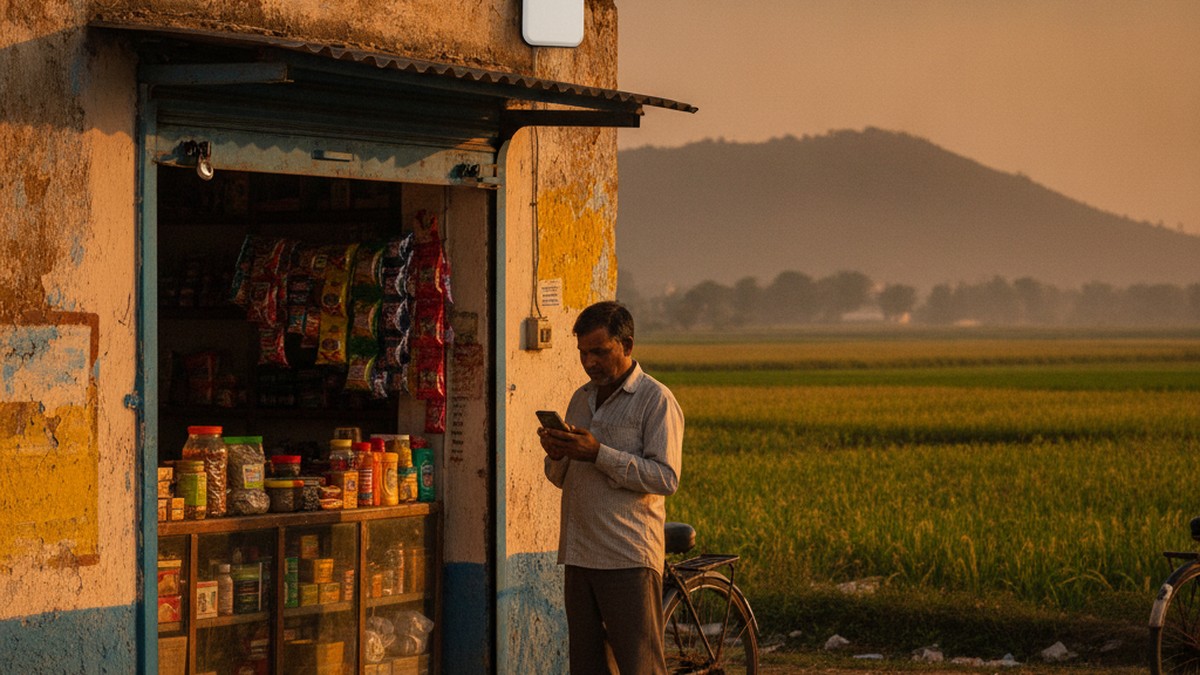
Why satellite spectrum broke India’s usual rules
To see why this matters beyond telecom, it helps to understand what actually happened in India’s spectrum debate, because it is more interesting than the “Starlink versus Jio” framing suggests. India’s entire approach to allocating scarce public resources has been shaped since 2012 by the Supreme Court’s judgment in the 2G spectrum case, which cancelled 122 licences and held that spectrum, as a scarce natural resource, should generally be assigned by auction rather than administrative discretion, precisely to prevent the kind of opaque, favour-driven allocation that had defined the scandal. That ruling became the load-bearing precedent for how India thinks about fairness in resource allocation, telecom and beyond.
Satellite spectrum broke the pattern. The Telecommunications Act, 2023 explicitly listed satellite spectrum among the resources to be assigned administratively rather than auctioned, and the government has stuck with that position through TRAI’s subsequent consultations. When the Centre later sought the Supreme Court’s clarification on extending the same logic more broadly, the court’s registry rejected the plea as “misconceived,” a procedural rebuff that nonetheless signalled how politically loaded any departure from the auction orthodoxy remains. Communications minister Jyotiraditya Scindia has defended the distinction on technical grounds, arguing in Parliament that satellite frequencies behave differently from terrestrial mobile bands and are governed by international coordination rather than domestic exclusivity. That argument is, inconveniently for the telcos, largely correct: almost nowhere in the world are satellite frequencies auctioned the way terrestrial mobile spectrum is. The International Telecommunication Union coordinates orbital slots and satellite frequency use through a filing and coordination process, not a domestic revenue auction, because the resource itself, a beam from an object in orbit over multiple jurisdictions, was never analogous to an exclusive block of nationally bound mobile spectrum in the first place. India’s decision was less a radical departure than a belated recognition that it had been trying to fit an international resource into a domestic auction framework built for a different kind of scarcity.
That recognition still has a price. TRAI’s May 2025 recommendation set a spectrum usage charge of roughly 4 percent of adjusted gross revenue for satellite operators, with the Department of Telecommunications reportedly considering pushing that closer to 5 percent. Compare that with what Jio, Airtel and Vodafone Idea paid for terrestrial spectrum over the past decade, sums that ran into billions of dollars per auction round, and the asymmetry the telcos were objecting to is real. It is simply not the asymmetry that determines who wins the next phase of Indian connectivity.
The market Starlink is actually fighting for
Roughly 40 percent of India remains effectively offline or underserved, concentrated in geographies where laying fibre or erecting towers is uneconomic: mountain terrain, forest cover, islands, and thinly populated agricultural belts. This is precisely the market satellite broadband is built for, and precisely the market Indian telcos have never been able to serve profitably. Starlink’s India pricing, reported around 2,500 to 3,500 rupees a month for speeds between 25 and 220 megabits per second, is roughly six to nine times the entry price of Jio’s mobile plans and well above its fibre offerings, which reach gigabit speeds for a few hundred rupees where infrastructure exists. Satellite is not arriving to undercut Jio’s urban and semi-urban core business. It is arriving to serve the segment at the edge of that business that Jio has always subsidised or simply left unaddressed.

India’s satellite broadband market is still small in absolute terms, estimated at around 394 million dollars in 2025, but projected to nearly quintuple to roughly 1.8 billion dollars by 2034 as hardware costs fall and coverage improves. Globally, the pattern rhymes: legacy satellite operators have spent the past three years consolidating defensively, Eutelsat merging with OneWeb, Viasat acquiring Inmarsat, SES combining with Intelsat, precisely because none of them could match a vertically integrated, reusable-rocket-subsidised constellation operating at Starlink’s scale, now more than 10,000 satellites, on its own. Amazon’s Kuiper is the only entrant with comparable capital and launch ambition. Everyone else is choosing between merging or partnering.
Why surrendering the network is the smart move
This is the part that should interest a CEO with no exposure to telecom or India whatsoever. Jio and Airtel did not lose their fight over spectrum pricing and then settle for the consolation prize of selling someone else’s hardware. They ran the numbers on a segment of the market they were already losing money to serve, concluded that no plausible spectrum price would make building their own satellite constellation rational against SpaceX’s amortised global cost base, and moved to own the part of the value chain that does not require matching that cost base: the retail relationship, the billing account, the customer’s trust, and increasingly, the bundled plan that blends fibre, mobile and satellite into a single subscription. They are, in effect, choosing to become the highest-value distribution channel for a competitor’s infrastructure rather than a marginal, subsidised operator of their own.
That is a more general lesson than it looks. Cable operators facing streaming did not out-invest content studios; the ones that survived became the broadband pipe and the aggregation layer for other people’s content. Retail banks facing well-capitalised fintech lenders increasingly white-label or partner rather than rebuild lending infrastructure from scratch. In each case, the incumbents who fared best were not the ones who fought hardest to preserve their old cost structure against an entrant with a structurally different one; they were the ones who worked out, early and unsentimentally, which layer of the value chain still rewarded scale they actually possessed, customer relationships, distribution reach, regulatory standing, brand trust, and rebuilt their strategy around defending that layer instead.
The uncomfortable question for any executive watching this from outside telecom is not whether their industry has a Starlink moment coming. Several already do, in AI compute, in payments infrastructure, in logistics networks built by platforms with different capital costs and different regulatory treatment than the incumbents they are displacing. The useful question is narrower and harder: which part of your own infrastructure exists mainly because building it yourself used to be the only option, and would you still build it today if a better-capitalised, differently regulated competitor offered to build it for you while you kept the customer? Jio and Airtel answered that question for the rural fringe of Indian connectivity in eighteen months. Most boards take considerably longer to admit the answer is yes.
There is a final irony worth sitting with. India spent over a decade treating spectrum auctions as the definitive proof that a resource allocation was fair, clean and free of favouritism, a lesson paid for in a genuine political scandal. Satellite spectrum has quietly demonstrated that the auction was never really the principle; capturing value from scarcity was. When the scarcity turns out to be global rather than national, orbital rather than terrestrial, the old proof of fairness stops applying, and the companies that adapt fastest are not the ones defending the old rule the loudest. They are the ones already selling the new entrant’s product from their own shop floor.