

Every CEO building data centres or chip capacity in 2026 has, by now, internalised the power problem. Utilities are signing multi-decade power purchase agreements with hyperscalers. Small modular reactor startups have more term sheets than they can staff for. Gas turbine order books at GE Vernova and Siemens Energy stretch out to 2030. None of this is cheap or easy, but it is, crucially, solvable with capital and contracts. Electricity can be generated, transmitted, stored and, if all else fails, bought from a neighbouring grid at a premium.
Water cannot. And that asymmetry is quietly becoming the more dangerous constraint on the entire AI-and-advanced-manufacturing buildout — one that most boards are still budgeting for as a utility line item rather than pricing as the strategic and geopolitical risk it has become.
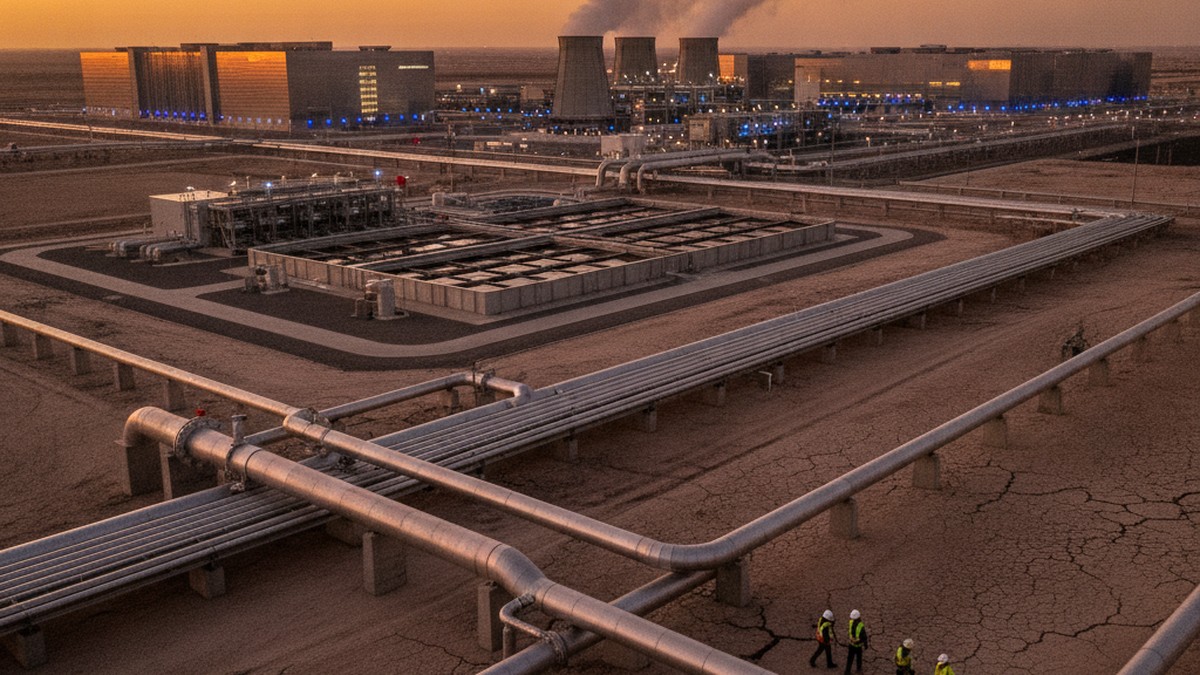
Start with the scale of what is being asked of local water systems. A modern semiconductor fab uses somewhere between 20 and 38 million litres of ultrapure water a day, roughly what a small city consumes. TSMC alone drew 101 billion litres in 2023, and that figure rises with every new node, since each additional layer of advanced logic requires more wafer-cleaning cycles. On the data centre side, Google reported consuming 10.9 billion gallons of water in 2025, a 34% jump from the year before and more than double what it used in 2021 — even as the company says it replenished 78% of that volume through recharge projects. Amazon disclosed water use for the first time last year: 2.5 billion gallons globally. Microsoft has cut its fleet-wide water intensity by nearly 40% since 2021 and is now deploying zero-evaporation cooling designs, precisely because it can see where this is heading. Across the United States, data centres consumed roughly 17.4 billion gallons directly for cooling in 2023, with a further 211 billion gallons used indirectly to generate their electricity — a figure some analysts project could triple by 2028.
Here is the part that should worry a chief financial officer more than the headline volumes: roughly 40% of existing semiconductor fabs, and more than 40% of every fab announced since 2021, sit in locations projected to face high or extremely high water stress by 2030, according to analysis from Bernstein and Robeco. Taiwan’s 2021 drought already forced TSMC to truck water to its fabs by tanker. The company is now building a 15-acre reclamation plant in Arizona designed to recycle 90% of its wastewater there, and Taiwan itself is planning eight seawater desalination plants largely to keep its chip industry running. That is not a resilience programme. That is an admission that the original site-selection models were wrong about the one input that cannot be shipped in from somewhere else.
Why water breaks the models that solved power
The reason water is harder to manage than electricity is not that there is less of it in absolute terms — it is that water markets barely exist. Power can be metered, priced, traded and contracted across borders because grids and generation are, in most of the world, commercial infrastructure with reasonably transparent pricing. Water rights, by contrast, are frequently allocated by municipalities or state agencies at prices that bear almost no relationship to scarcity, which means a site can look financially attractive for years right up until the local aquifer or reservoir hits a wall — at which point the cost is not a marginally higher tariff but a stalled or cancelled asset. It is also hyperlocal in a way power rarely is: two data centres fifty miles apart, sitting on the same electrical grid, can face entirely different water futures depending on which watershed, aquifer or municipal system they draw from. And unlike a power shortfall, which shows up as a rate increase or a curtailment notice, a water shortfall shows up as a community that no longer consents to the project at all.
That consent problem is no longer theoretical. More than 75 data centre developments worth a combined $130 billion were successfully blocked or delayed in the United States in just the first four months of 2026, according to tracking by Data Center Watch, with local opposition citing water and power costs as the two leading objections — and 2026’s total delays had already exceeded all of 2025’s before the year was half over. Texas, one of the most permissive states for data centre construction, requires water-use reporting from large facilities; an audit found 83% of its 341 data centres were non-compliant, with penalties capped at a token $500. Regulation, in other words, has not caught up with the industry it is meant to govern, and the gap is being filled — messily, unpredictably — by local politics instead.
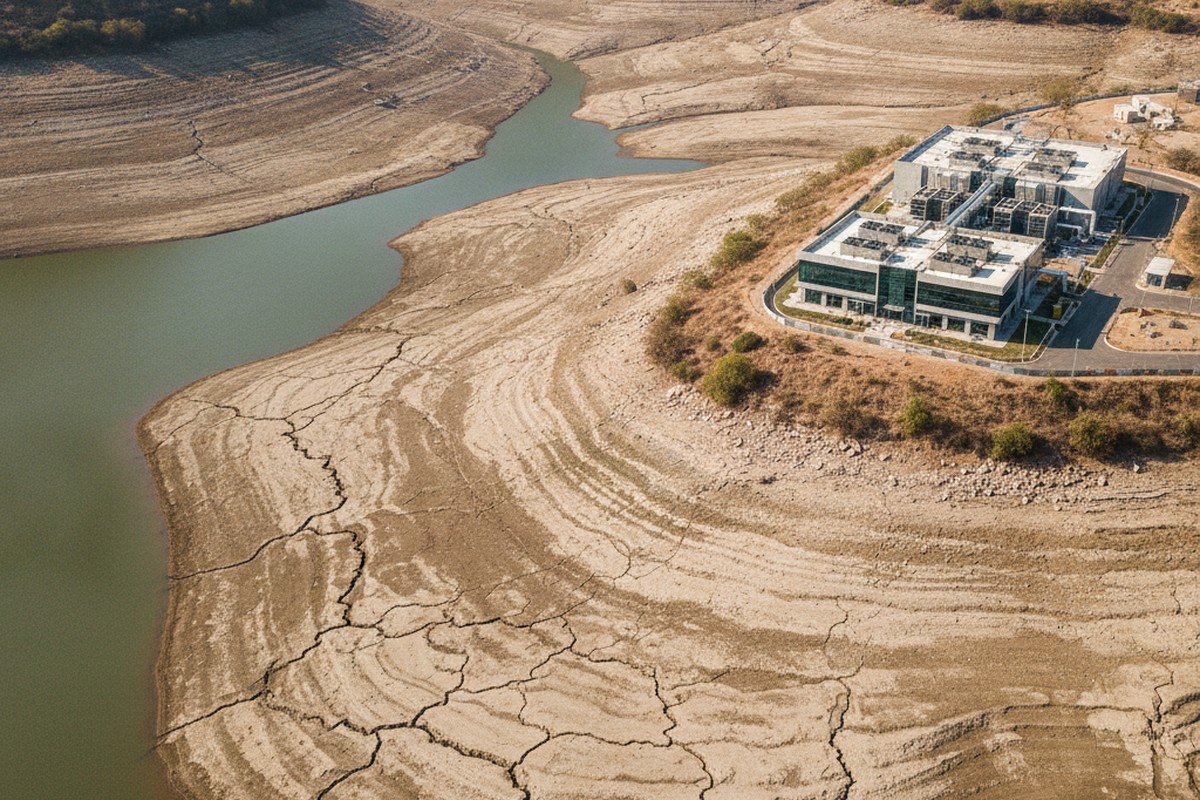
India shows both halves of the problem at once
Nowhere is the collision between digital ambition and water reality sharper than in India, which is simultaneously one of the most attractive destinations for data centre and semiconductor capital and one of the most water-stressed large economies on earth. Indian data centres consumed an estimated 150 billion litres of water in 2025, a figure projected to more than double to roughly 358 billion litres by 2030 as capacity expands from about 1.5 gigawatts today toward an additional 8 to 10 gigawatts by the end of the decade, backed by more than $167 billion in committed investment from Microsoft, Amazon, Google and Adani Group among others. Much of that capacity is being planned for exactly the cities least equipped to supply it: Bengaluru, which endured what local officials called its worst water crisis in nearly five centuries in 2024; Hyderabad, projected to face a daily water deficit of 870 million litres by 2027 even as hyperscalers continue expanding there; and Chennai, which hit “Day Zero” — its reservoirs completely dry — in 2019 and remains a sought-after location regardless. Micron’s $2.75 billion assembly and test facility in Sanand, Gujarat, opened this year in a semi-arid region already under agricultural and industrial water demand, betting that infrastructure investment can outrun hydrology.
Then there is the geopolitical layer, which India has just made concrete in a way every multinational should study closely. After the April 2025 Pahalgam attack, India suspended the Indus Waters Treaty — an agreement that had survived three wars and six decades of hostility with Pakistan without being touched. The suspension gave India latitude over upstream dam operations, flushing schedules and data-sharing that it did not previously exercise, and while diplomats on both sides describe it as a pause rather than a permanent rupture, the signal is unambiguous: a government will now treat shared river water as an instrument of state power, not merely a technical utility matter. Any company with capital tied to a river basin shared between unfriendly states — the Nile between Ethiopia and Egypt, the Mekong across Southeast Asia, the Amu Darya in Central Asia — just watched a precedent get set. Water access, long treated as apolitical plumbing, is being reclassified as sovereign leverage.

What this means for capital allocation
The World Resources Institute estimates that $70 trillion of global GDP, 31% of the total, will be exposed to high water stress by 2050, up from $15 trillion in 2010 — and that India, Mexico, Egypt and Turkey alone will account for more than half of that exposure. That is not a sustainability footnote; it is a map of where industrial capital is being deployed fastest and where its water assumptions are weakest. The UN Secretary-General’s AI Environmental Transparency Initiative, launched in June 2026, will eventually force major AI companies to disclose water use alongside carbon, but disclosure regimes for water remain years behind those for carbon, and CDP’s own scoring criteria are still being rewritten to catch up with how fast the exposure is growing.
For a board, the practical implication is not to abandon water-stressed geographies — that would mean abandoning much of India, the American Southwest and large parts of the Gulf, none of which is realistic given where growth, talent and policy incentives actually are. It is to stop treating water like a metered cost and start treating it like a scarce, negotiated, occasionally weaponisable asset that must be secured years ahead of a groundbreaking, not permitted just before one. That means underwriting recycling and reclamation infrastructure into the initial capital cost of a fab or data centre rather than retrofitting it after a drought; running community consent as a parallel workstream to the environmental permit rather than assuming the permit is sufficient; and, for any site dependent on a transboundary river system, treating water diplomacy as a genuine line item in enterprise risk, not a footnote for the sustainability team. The companies that treated land banks and spectrum licences as strategic assets a generation ago built durable advantages that outlasted several product cycles. Water rights, quietly, are becoming the next version of that same bet — and most of the industry has not yet noticed it is being placed.