

When Walmart’s e-commerce chief Daniel Danker quietly told reporters this spring that purchases made through ChatGPT converted at roughly a third of the rate of purchases made on Walmart’s own site, it should have been a bigger story than it was. For eighteen months, the loudest claim in retail technology has been that AI agents are about to do our shopping for us: browsing, comparing, deciding, paying, all without a human ever touching a “buy” button. Danker’s number, echoed by Etsy’s own muted admission that its September 2025 launch partnership with OpenAI never became a meaningful sales channel, was the first hard data point in that story. It suggested the opposite of the hype: given the chance to let a chatbot complete a purchase autonomously, most people didn’t take it.
That is not evidence that agentic commerce is a dead end. It is evidence that everyone, including OpenAI, initially answered the wrong question. The interesting fight was never really about whether a language model can find you a good pair of running shoes. It is about who gets to own the plumbing that lets a piece of software prove, to a bank, a merchant and a regulator, that it is acting on a real person’s authority when it spends their money. That plumbing is being built right now, in at least three incompatible versions, by organisations that each have very different incentives for how it should work. For CEOs, CFOs and boards, that is the part of this story worth paying attention to, because it will quietly determine which companies control customer relationships in a decade, not which chatbot answers the most questions correctly.
The checkout button was never the hard problem
OpenAI’s Instant Checkout, launched with Etsy and Shopify and built on an open-sourced Agentic Commerce Protocol co-developed with Stripe, was engineered to solve a UX problem: letting a user “confirm order, shipping and payment details” without leaving a chat window. It was a reasonable bet, given that ChatGPT had roughly 700 million weekly users and access, through Shopify alone, to more than a million merchants. But the retreat that followed, reported by CNBC and Modern Retail through the first quarter of 2026, exposed something more structural. Large retailers held back specifically because the feature lacked real-time inventory syncing, coupon logic, loyalty-programme integration and, most importantly, any mechanism for the merchant to retain the customer relationship. Marshal Cohen of Circana put the retailer’s real objection plainly: handing a chatbot control of the customer base turns a branded relationship into “a commodity-based business.” Most large retailers responded not by refusing agentic commerce but by building their own branded assistants inside ChatGPT for discovery, while keeping checkout, data and loyalty on their own infrastructure. They wanted the traffic. They did not want to become an anonymous SKU inside someone else’s cart.
That instinct is correct, and it points to what the next phase of this fight is actually about: not whether agents can shop, but who controls the record of what was authorised, by whom, under what conditions, and who is liable when it goes wrong.
The real product is the mandate, not the chatbot
Google’s answer to that question, the Agent Payments Protocol, is far more interesting than another shopping assistant, because it is not trying to be one. AP2, released with more than sixty partners spanning Mastercard, Visa, American Express, PayPal, Stripe, Coinbase, Salesforce and Shopify, is a specification for something called a mandate: a cryptographically signed, tamper-proof digital contract that records a user’s intent, the exact cart an agent assembled, and the payment authorisation tied to it. For a live, human-present purchase, the mandate creates an unforgeable link between “this is what I asked for” and “this is what I paid for.” For a delegated task, such as an agent instructed to buy a flight only if it stays under a set price, the mandate encodes the conditions up front and generates proof of compliance automatically when it acts. Visa and Mastercard have built their own tokenisation layers on top of the same idea, restricting an agent’s spending authority to specific merchants and amounts, revocable at any time.
This is, in effect, a rerun of an old argument in technology in a new guise. Whoever owns the interface earns attention. Whoever owns the trust layer underneath it earns durable economic power, because every transaction has to clear through their rules. Search engines learned to monetise attention; the companies now racing to define agent-to-merchant trust are building for something closer to what card networks and identity providers extract today: a small, compounding toll on every transaction that runs through infrastructure nobody else controls.
Forrester’s 2026 commerce predictions describe the second-order consequence directly: as answer engines aggregate inventory from platforms like Etsy and Shopify and present it inside a single conversational interface, independent retail marketplaces lose their reason to exist, and Forrester expects roughly a third of standalone marketplace projects to be abandoned as a result. Brands that spent a decade optimising for search rankings now face a parallel discipline: making their product data legible to an agent that never visits a webpage, never sees a banner ad, and evaluates offers on structured attributes rather than brand story. Being invisible to an AI agent’s decision logic will soon carry the same commercial cost that being invisible to Google search once did, except the audit trail for why an agent chose a competitor’s product will be far harder to reconstruct than a keyword ranking ever was.

Why India’s plumbing might already be built
This is where the Indian case becomes genuinely instructive rather than a token addition to a global argument. The National Payments Corporation of India has been developing what people close to the project describe as a Unified Agent Protocol, designed to let AI agents originating from ChatGPT, Claude, merchant apps or dedicated shopping assistants transact over UPI, the rail that already clears more than 22 billion transactions worth roughly ₹29 trillion a month. Rather than retrofitting tokenisation onto decades-old card infrastructure, as Visa and Mastercard are effectively doing, NPCI can extend delegated-payment logic that already exists inside UPI Circle, verifying and authorising agents centrally while deliberately not seeing the underlying purchase details. Layered on top is Beckn, the open commerce protocol behind the Open Network for Digital Commerce, and an early demonstration called BecknGPT that lets a conversational agent transact directly across ONDC’s network of small retailers, restaurants and service providers without any single company sitting in the middle taking a cut.
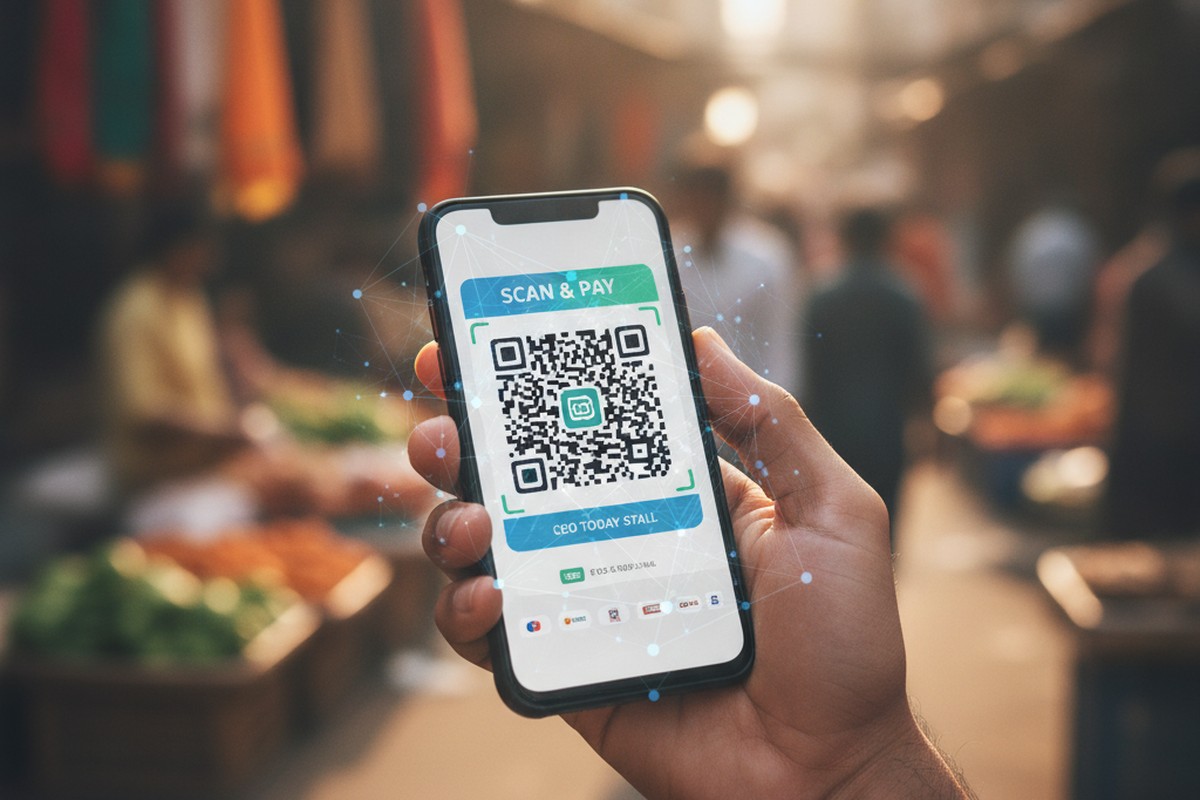
The structural difference matters. The United States and Europe are trying to bolt agent trust onto a commercial payments system built by and for a handful of private networks, each with its own commercial incentive to own the resulting toll. India is trying to extend a payments and identity stack that was built, from the outset, as public digital infrastructure, interoperable by design and not owned by any single company. If it works, Indian merchants of any size could plug into agentic commerce at close to zero marginal integration cost, an advantage no card-network-mediated market can easily replicate. That is a genuine structural head start, not just an adoption statistic.
It is not a guaranteed one. NPCI’s own people acknowledge that dispute resolution is the unresolved question: when an agent authorised to spend within limits still buys the wrong thing, or is manipulated into an unwanted purchase, nobody has yet defined who absorbs the loss, and the protocol cannot launch without RBI sign-off on exactly that point. The infrastructure lead means little if the liability framework around it arrives late or badly designed.
What this means before the standard is settled
None of this is a call to bolt agent checkout onto every product page. The lesson of Instant Checkout’s stumble is that consumers do not yet trust autonomous purchasing, and companies that raced ahead of that trust gave up leverage for nothing. The more useful posture for a leadership team is threefold: get product and pricing data into machine-readable formats now, because whichever protocol wins, structured legibility to an agent will matter more than a beautifully designed website; make sure whoever owns payments and risk in the organisation understands mandates and tokenised authorisation before someone lower down signs up for an “autonomous replenishment” pilot with no clarity on liability; and treat the choice of which protocol stack to build for, Stripe-anchored, card-network-anchored, or UPI-and-Beckn-anchored, as a genuine strategic decision tied to geography, not a technical footnote left to the engineering team. The interface war got the headlines. The infrastructure war is the one that will decide who keeps the customer.